


AI-First Service Firms and Self-Improving Organisations
By Grant Crawley · 7 June 2026
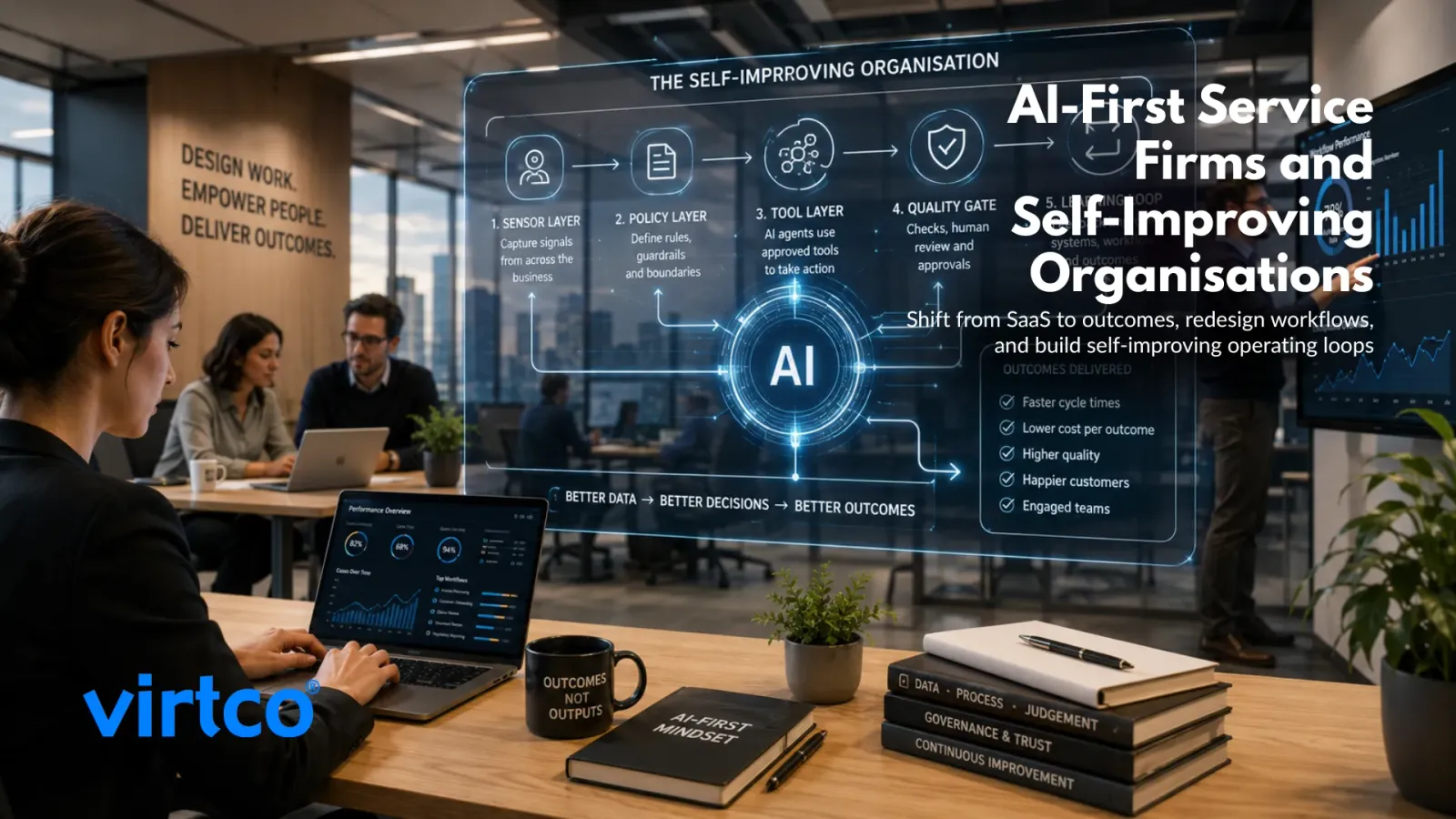
The service economy is moving from selling software access to selling completed outcomes.
For more than two decades, the dominant enterprise model was software as a service (SaaS). Vendors sold licences, subscriptions and seats. Customers then supplied the people, process knowledge and management effort needed to turn that software into a useful result.
Artificial intelligence changes that model. AI-first service firms do not simply provide tools for people to operate. They use AI as part of the operating model itself, delivering completed work such as drafted filings, processed claims, reviewed documents, structured reports, reconciled data or customer service resolutions.
That shift matters because it changes the economics of the organisation. The scarce resource is no longer only human labour. Increasingly, it is the quality of the workflow, the data context, the governance model and the feedback loop that allows the system to improve.
For organisations exploring this shift, the question is not, “Which AI tool should we buy?” A better question is, “Which business outcome can we redesign around AI, automation and human judgement?”
From SaaS to outcomes as a service
Traditional SaaS captures value at the interface layer. The vendor provides software. The customer logs in, applies human effort and produces the output.
Outcomes as a service (OaaS) changes the unit of value. The customer pays for the completed result, not merely for access to the system used to produce it.
| Dimension | Traditional SaaS | AI-first services |
|---|---|---|
| Core value unit | Licences, seats and application programming interface (API) access | Completed, verified operational outcomes |
| Customer burden | The customer supplies most of the workflow labour | The provider absorbs and automates much of the workflow |
| Pricing model | Per user, per seat or tiered subscription | Per case, per result, per workflow or value-aligned fee |
| Scaling constraint | Headcount, management capacity and implementation complexity | Data quality, workflow design, model performance, governance and token cost |
| Human role | Primary operator | Supervisor, exception handler, relationship owner and decision maker |
This does not mean people disappear from the process. It means they move to the right part of the process.
AI-first organisations use automation for repeatable, structured and high-volume work. Humans remain essential for trust, judgement, empathy, escalation, commercial negotiation, ethics, accountability and genuinely novel cases.
Why the economics are different
Traditional professional services scale in a broadly linear way. More work usually requires more people.
A simplified model looks like this:
Revenue = price per person-hour × human hours delivered
AI-first services aim to break that dependency. They still need skilled people, but the relationship between revenue and headcount becomes less direct.
A more useful model is:
Revenue = automated outcome volume × workflow efficiency + human exception value
In practice, this means that margin improvement does not come only from making people work faster. It comes from redesigning the work so that routine steps are handled by reliable systems, with people focused on the moments where their judgement creates the most value.
That is also why an AI-first service firm cannot be built by bolting a chatbot onto an existing process. If the old process is slow, fragmented or poorly measured, AI will simply expose that weakness faster.
Choosing the right market for AI-first services
Not every service workflow is a good candidate for AI-first delivery. The strongest opportunities usually share five characteristics.
1. The customer values the outcome more than the process
Customers must care more about the quality, speed and compliance of the final result than about who performed every intermediate step.
Examples might include:
- invoice processing
- first-pass legal document review
- customer support triage
- regulatory evidence gathering
- reporting packs
- onboarding workflows
- claims administration
2. The workflow is repeatable
The work should contain identifiable patterns, rules, documents, decisions and hand-offs. If every case is entirely bespoke, the automation opportunity is weaker.
3. The work has enough complexity to justify AI
Simple scripts are enough for simple automation. AI becomes valuable where the work involves unstructured data, natural language, judgement support or multiple systems that need to be interpreted together.
4. The risks can be governed
AI-first does not mean uncontrolled automation. The organisation must be able to define what the system can do autonomously, what needs approval and what must always remain with a human decision maker.
5. The work happens mainly on screens
Pure digital workflows are better suited to AI-first service models than work that depends on physical presence, equipment, site access or manual handling. Physical operations may still benefit from AI, but the operating model is different.
Avoiding the early demand trap
AI-first service firms often face a tempting problem: demand arrives before the system is ready.
A cheaper, faster service is attractive, so early customers may be willing to pilot quickly. The risk is that the team then fulfils the work manually behind the scenes while telling itself that automation will come later.
That creates a disguised agency model. Revenue grows, but the underlying system does not improve.
To avoid this trap:
- cap the number of early pilot customers
- measure manual effort honestly
- automate the highest-friction steps first
- build feedback capture into every workflow
- separate customer delivery time from system-building time
- refuse work that does not teach the system something reusable
A pilot should prove the operating model, not just prove that the founding team can work long hours.
The architecture of a self-improving organisation
A self-improving organisation is not just a company with AI tools. It is an organisation designed so that operational data, decisions, actions and feedback continually improve the way work gets done.
A practical model has five layers.
1. Sensor layer
The sensor layer captures the signals entering the business.
These may include:
- customer emails
- support tickets
- sales calls
- meeting notes
- product telemetry
- operational logs
- finance records
- customer relationship management (CRM) updates
- project changes
- complaints, cancellations and escalations
If the organisation does not capture the signal, the system cannot learn from it.
2. Policy layer
The policy layer defines the rules.
It answers questions such as:
- What can the AI do without approval?
- What must be reviewed by a person?
- Which data can be used?
- Which systems can the agent access?
- What are the compliance boundaries?
- What should happen when confidence is low?
This layer is where business rules, legal obligations, brand standards, security policies and risk appetite become operational controls.
3. Tool layer
The tool layer is where actions happen.
AI agents may call approved tools to:
- query a database
- update a record
- draft a response
- prepare a document
- create a task
- schedule a meeting
- raise an alert
- summarise a file
- route a case to the right team
The important point is that tools should be deterministic, permissioned and observable. The AI should not be allowed to improvise unrestricted actions in business-critical systems.
4. Quality gate
The quality gate sits between recommendation and action.
It may include:
- automated checks
- confidence thresholds
- policy validation
- human review
- audit logging
- approval workflows
- exception routing
This is where the principle of human-in-the-loop becomes practical. In a well-designed pilot, the AI may draft the email, prepare the analysis or recommend the next step, but a person reviews and approves anything that carries material risk.
5. Learning mechanism
The learning mechanism closes the loop.
It captures:
- errors
- edge cases
- rejected recommendations
- corrected outputs
- customer responses
- escalation reasons
- process delays
- successful resolutions
Those signals are then used to improve prompts, rules, retrieval sources, training material, workflow design and governance.
The organisation becomes better not because someone writes a quarterly lessons-learned report, but because the operating system of the business is designed to learn continuously.
The shared organisational brain
AI-first organisations need a reliable source of context. Without it, agents are forced to work from partial information, duplicated files and conflicting versions of the truth.
That shared organisational brain usually includes:
- structured databases
- approved document repositories
- process maps
- customer records
- policies
- reusable prompts
- standard operating procedures
- decision logs
- integration histories
- performance data
The goal is not to centralise everything for its own sake. The goal is to make operational knowledge searchable, governable and reusable.
Virtco’s own approach to AI adoption reflects this principle. Effective AI transformation starts by finding the real business bottleneck, establishing a baseline, proving a controlled pilot, supporting adoption and then scaling through connected agents rather than isolated tools.
Security, access and control
The more capable an AI system becomes, the more important governance becomes.
For AI-first operations, security should be designed into the architecture from the start. Practical controls include:
- read-only access where possible
- role-based access control
- row-level security (RLS) for tenant or departmental separation
- audit logs for agent actions
- approval gates for sensitive activity
- restricted tool registries
- sandbox environments for testing
- clear data retention rules
- escalation paths for uncertain outputs
A useful design pattern is to separate reasoning from execution. The AI can recommend or request an action, but a constrained service performs the action only if the request passes policy checks.
This reduces the risk of an agent taking unauthorised action while still allowing the organisation to automate meaningful work.
How AI changes software engineering
AI-assisted development changes the bottleneck in software delivery.
When code generation becomes faster, the scarce capability shifts towards:
- problem definition
- architecture
- security review
- test design
- integration quality
- product judgement
- maintainability
- user adoption
In other words, writing code faster is useful only if the organisation is clear about what should be built and why.
| Activity | Legacy software delivery | AI-assisted delivery |
|---|---|---|
| Writing code | A major time constraint | Faster, but still needs review |
| Testing | Often compressed under deadline pressure | Becomes more important because output volume increases |
| Architecture | Discussed before implementation | Can be explored through multiple generated prototypes |
| Documentation | Often separate from the codebase | Should be close to the code and kept current |
| Review | A downstream step | A central control point |
| Adoption | Sometimes treated as post-launch activity | Must be designed from the start |
The danger is not that AI writes code. The danger is that teams generate more code than they can understand, review, secure or support.
This is why AI-first engineering needs stronger quality gates, not weaker ones.
Flat teams and clearer accountability
AI-first operating models often reduce the need for coordination layers whose main role is passing information between teams.
That does not remove the need for leadership. It changes what leadership does.
Managers and senior specialists need to:
- define outcomes
- remove ambiguity
- set decision rights
- maintain standards
- review exceptions
- coach teams
- prioritise work
- ensure adoption
- protect customers and staff from poorly governed automation
A useful principle is to assign a directly responsible individual for every important operational outcome. Agents can support the work, but accountability must remain human.
Metrics for AI-first service firms
AI-first transformation should be measured in operational terms, not just technology terms.
Useful metrics include:
- cycle time reduction
- cost per completed outcome
- number of cases handled per full-time equivalent (FTE)
- percentage of work completed without rework
- escalation rate
- customer satisfaction
- employee adoption
- exception volume
- audit pass rate
- time saved per workflow
- revenue per FTE
- quality review pass rate
- model or workflow failure rate
The key is to measure before and after. If there is no baseline, there is no credible return on investment story.
This is where many AI projects fail. They start with a tool, not a business case. They then struggle to prove value because they never measured the old process properly.
A practical roadmap for becoming AI-first
The transition to an AI-first service model should be deliberate. A measured roadmap is safer than a broad, unfocused programme.
1. Find the friction
Start with business pain, not technology.
Ask:
- Where are we slow?
- Where are customers waiting?
- Where do people copy and paste data?
- Where do errors repeat?
- Where do managers chase updates?
- Where does work queue up?
- Which process is expensive, measurable and repeatable?
Use an impact versus feasibility matrix. Avoid the moonshot first. Choose a workflow that is valuable enough to matter and contained enough to prove.
2. Establish the baseline
Before building anything, measure the current process.
Capture:
- time spent
- cost per case
- error rates
- rework
- hand-offs
- customer impact
- systems involved
- compliance risks
- staff frustration
A baseline turns AI from an experiment into a business case.
3. Build a controlled pilot
The first pilot should be narrow, safe and measurable.
A good pilot has:
- a clear outcome
- a defined user group
- limited system access
- human review
- test data or a sandbox where appropriate
- explicit success criteria
- feedback capture
- a rollback plan
The aim is not to automate the whole business in one step. The aim is to prove that one workflow can be improved safely.
4. Design for adoption
The technology is often easier than the people side.
Teams need to understand:
- why the change is happening
- how their work will change
- what the AI can and cannot do
- how to challenge outputs
- when to escalate
- how success will be measured
Position AI as a way to remove drudgery and improve service quality, not as a vague threat. Adoption should be built into the programme from day one.
5. Scale through connected agents
Once one workflow is proven, the next step is not to buy disconnected AI tools across every department.
The stronger model is an agentic mesh: a connected set of agents, workflows, systems and data sources that can support end-to-end business outcomes.
For example:
- a sales agent captures and qualifies demand
- an onboarding agent prepares customer setup tasks
- a finance agent checks billing data
- a support agent monitors early issues
- a reporting agent summarises progress for managers
The value comes from the connection between workflows, not from isolated automation.
What to keep permanent and what to treat as temporary
AI tools, models and interfaces will keep changing. Organisations should avoid locking their operating knowledge inside one vendor interface or one short-lived application.
The durable assets are:
- proprietary data
- customer knowledge
- process understanding
- domain expertise
- policies
- evaluation criteria
- workflow maps
- trusted content
- audit trails
- outcome metrics
The less durable assets are:
- individual prompts
- prototype interfaces
- internal dashboards
- temporary scripts
- model-specific implementation details
Treat software as adaptable. Treat context as strategic.
That means keeping business knowledge in structured, portable and well-governed formats wherever possible.
The leadership challenge
The AI-first organisation is not simply a technical destination. It is a management discipline.
Leaders need to make clear decisions about:
- which outcomes matter
- which workflows deserve investment
- which risks are acceptable
- which human decisions must never be delegated
- which data is trusted
- which teams own which results
- how adoption will be supported
- how performance will be measured
Without that clarity, AI becomes another layer of complexity. With it, AI can become a practical way to increase capacity, improve service quality and reduce operational drag.
Conclusion: the self-improving organisation is designed, not bought
AI-first service firms are not created by purchasing a new tool. They are created by redesigning work around outcomes, data, governance, feedback and human judgement.
The organisations that benefit most will not be those that automate the most activity blindly. They will be those that choose the right workflows, measure the baseline, build safe pilots, keep humans in the right places and create learning loops that improve with every case.
For UK small and mid-sized businesses, the opportunity is practical rather than futuristic. Start with one painful workflow. Prove the value. Build the governance. Train the team. Then scale carefully.