


Augmented Reality, Virtual Reality and AI Glasses
By Grant Crawley · 14 April 2026
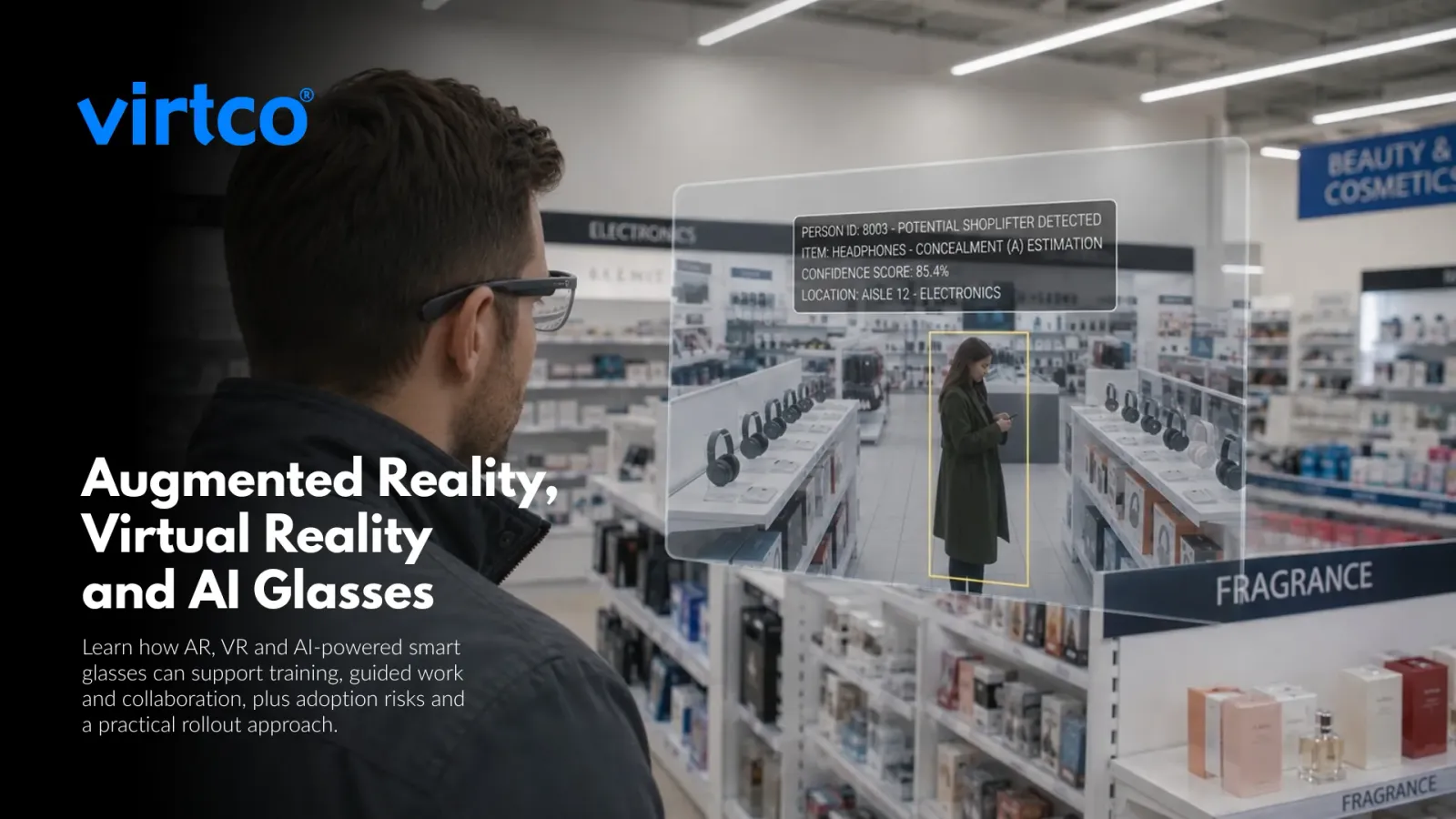
Augmented reality (AR) and virtual reality (VR) are technologies that change how people experience digital information.
AR adds digital elements to the real world. That might mean instructions overlaid on equipment, a remote expert annotating what a field engineer can see, or an artificial intelligence (AI) assistant using a camera to answer questions about the user’s surroundings.
VR creates a fully artificial environment. It is most useful when the user needs to practise, visualise or collaborate inside a simulated space that would be difficult, dangerous or expensive to recreate physically.
The category has changed significantly. The early promise of a headset-led “metaverse” has cooled, especially in the workplace. Several large technology providers have reduced, retired or repositioned parts of their AR and VR portfolios. Microsoft has said Dynamics 365 Guides and Remote Assist will no longer be available after 31 December 2026, while HoloLens 2 has reached its final feature release, with security servicing continuing to December 2027. (learn.microsoft.com) Meta has also moved away from some business-focused VR products, with Horizon Workrooms closing on 16 February 2026 and commercial Quest headset sales being pulled back. (techradar.com)
At the same time, smart glasses are becoming more practical. The market is shifting away from heavy, immersive headsets for every use case and towards lighter AI-powered eyewear that supports short, useful interactions in the flow of work. IDC reported that the extended reality (XR) market grew 44.4% in 2025 and expects 33.5% growth in 2026, with most of that growth coming from smart glasses without displays. (idc.com) Counterpoint Research also reported strong smart glasses growth through 2025, with AI smart glasses taking a much larger share of shipments. (counterpointresearch.com)
From metaverse ambition to practical spatial computing
The most important update is strategic rather than technical: organisations should not treat AR and VR as a single bet on immersive worlds.
Instead, they should separate the market into three practical categories:
- Virtual reality for controlled simulation, training, design review and immersive collaboration.
- Augmented reality for contextual overlays, guided work, visual support and digital twins in real environments.
- AI-powered smart glasses for hands-free capture, translation, voice assistance, task support and lightweight workplace interaction.
That distinction matters because the business case is different in each category. VR asks the user to step out of the physical workplace and into a synthetic one. AR and smart glasses increasingly bring support into the physical workplace itself.
This is why the recent growth in AI glasses is significant. They do not require every meeting, training session or workflow to become immersive. They solve smaller, more frequent problems: “What am I looking at?”, “Translate this sign”, “Capture this inspection”, “Summarise my messages”, “Guide me to the next step”, or “Let a remote colleague see the issue without me holding a phone.”
Why AI-powered AR glasses are gaining attention
Earlier AR headsets often struggled with weight, cost, comfort, battery life, social acceptability and narrow enterprise use cases. Newer AI glasses are not yet a full replacement for high-end AR headsets, but they are improving where adoption often fails: everyday wearability and immediate utility.
Recent product direction shows the change. Meta’s Ray-Ban Display glasses include an in-lens display and a neural wristband for subtle hand control, designed for short interactions rather than permanent screen use. (about.fb.com) Meta has also expanded prescription-focused AI glasses, describing newer frames as lighter, more comfortable and better suited to all-day eyewear. (about.fb.com) Google has announced Android XR intelligent eyewear with Gemini support, including audio glasses and display glasses for navigation, translation, messaging, photo capture and app-based task support. (blog.google)
The direction is clear: the next phase of AR is less about placing people into a branded virtual world, and more about putting AI, vision, audio and context into normal-looking eyewear.
For business leaders, that means the question is no longer simply “Should we invest in VR?” It is:
- Where would hands-free visual assistance remove friction?
- Where would live translation, capture or documentation improve service?
- Where would a worker benefit from contextual guidance without opening a laptop or phone?
- Where would AI need to understand the physical environment, not just text on a screen?
How AR and VR can support the modern digital workplace
AR and VR can still improve communication, training and collaboration, but the strongest use cases are specific.
Training and simulation
VR is well suited to situations where practice matters but real-world rehearsal is expensive, unsafe or disruptive. Examples include safety procedures, emergency response, customer interaction training, equipment familiarisation and complex operational scenarios.
The value is not simply that training feels more engaging. The value comes when people can repeat realistic scenarios, make decisions, receive feedback and build confidence before working in a live environment.
Field service and frontline work
AR and AI glasses can help people who work away from a desk. A technician, inspector, healthcare worker, engineer or site supervisor may need both hands free while accessing information, capturing evidence or receiving remote support.
Potential uses include:
- step-by-step maintenance instructions;
- visual quality checks;
- remote expert support;
- equipment identification;
- inspection capture;
- translation for international teams;
- voice notes converted into structured records;
- safety prompts and escalation workflows.
Design, engineering and digital twins
AR and VR can help teams understand complex spaces, products and assets before changes are made physically. Three-dimensional models can be reviewed at scale, design options can be compared, and teams can identify issues earlier.
This is particularly relevant for manufacturing, construction, engineering, facilities and asset-intensive sectors where mistakes in the physical world are costly.
Collaboration and knowledge sharing
VR meeting rooms attracted early attention, but adoption has been uneven. The more durable opportunity may be narrower: immersive workshops, design reviews, training cohorts and specialist collaboration where spatial presence adds value.
For everyday meetings, standard collaboration tools are often enough. For visual, spatial or physical tasks, AR and VR can add something genuinely different.
Specific benefits of AR, VR and AI glasses
Used well, these technologies can support:
- improved visualisation and understanding of complex data, spaces or processes;
- safer and more repeatable training experiences;
- faster support for remote, frontline and field workers;
- reduced travel for some expert support and training activities;
- better capture of real-world context;
- improved accessibility through translation, audio support and hands-free interaction;
- faster onboarding where employees need to learn physical processes;
- fewer errors where workers need instructions at the point of need.
The strongest benefits usually appear when AR or VR is connected to existing systems: asset registers, Microsoft 365, customer relationship management (CRM), enterprise resource planning (ERP), knowledge bases, service desks, workflow tools and reporting dashboards.
Potential drawbacks and adoption risks
There are still important constraints.
- Cost: Devices, management tools, content creation, integration and support can be expensive.
- Comfort: Some users may experience fatigue, discomfort or motion sickness, particularly in VR.
- Battery life and durability: Workplace use often demands longer sessions, ruggedisation and reliable charging routines.
- Privacy: Camera-enabled glasses create obvious concerns around consent, recording, data storage and bystander privacy.
- Security: Devices may capture sensitive operational, customer or employee data.
- Integration: A headset or pair of glasses is rarely useful if it cannot connect to the systems where work is managed.
- Change management: Staff may resist devices that feel intrusive, awkward or poorly explained.
- Vendor risk: Recent product retirements show why buyers should avoid over-reliance on one proprietary platform.
The lesson from discontinued metaverse and mixed reality products is not that AR or VR has failed. It is that adoption depends on measurable utility, not novelty.
A practical adoption approach
AR, VR and AI glasses should be assessed like any other digital workplace investment: start with the outcome, not the device.
A sensible approach is:
- Define the work problem. Identify where people lose time, make errors, wait for expert help or struggle to access information.
- Choose the right modality. Use VR for simulation, AR for visual overlays, and AI glasses for lightweight hands-free assistance.
- Check data and integration readiness. Confirm what systems, documents, images, workflows and permissions the solution will need.
- Run a small pilot. Test one workflow with a small user group before buying devices at scale.
- Measure the baseline and the result. Tr errors, faster training, reduced travel, better first-time fix rates or improved evidence capture.
- Design governance early. Cover privacy, consent, acceagement, retention and support.
- Scale only what works. Retire weak experiments quickly and expand the use cases that show measurable value.
This fits virtco®’s broader approach to digital transformation: solve the business problem first, then select the technology. virtco® combines more than 30 years of complex business problem-solving with current capability in AI-powered automation, Microsoft 365, custom software, mobile apps, integration, cybersecurity, compliance and digital workplace adoption. Its methodology emphasises seamless integration into existing business processes and practical user adoption rather than technology deployment for its own sake.
Where AR and VR are most credible now
The strongest near-term opportunities are likely to be:
- VR training where mistakes are costly or safety-critical;
- AR-guided work for engineering, maintenance, inspection and healthcare-like workflows;
- AI glasses for frontline productivity, including translation, capture, documentation and support;
- immersive design review for products, buildings, assets and environments;
- remote expert assistance where specialist knowledge is scarce;
- accessibility and inclusion, especially where hands-free audio, translation or contextual support helps people work more effectively.
The weakest opportunities are usually broad, vague “metaverse” programmes without a specific operational problem, owner, baseline or success measure.
How virtco® can help
For most organisations, the question is not whether AR, VR or AI glasses are interesting. It is whether they can create measurable value without adding complexity, risk or another disconnected platform.
virtco® can help assess where immersive and spatial technologies fit into a wider digital workplace, AI and automation roadmap. That includes:
- identifying high-friction workflows;
- mapping field, frontline and knowledge-worker processes;
- designing small, measurable pilots;
- integrating AI, automation and workflow systems;
- advising on security, privacy and governance;
- supporting adoption, training and change management;
- building custom applications or interfaces where off-the-shelf tools are not enough.
AR and VR are moving into a more mature phase. The winners will not be the organisations that chase every new headset. They will be the ones that apply spatial computing and AI where they genuinely improve the work.
Talk to virtco® if you want a practical view of where AR, VR or AI-powered smart glasses could support your operating model, your workforce and your measurable business outcomes.