


Fact-Checking AI-Generated Output with AI
By Grant Crawley · 2 July 2026
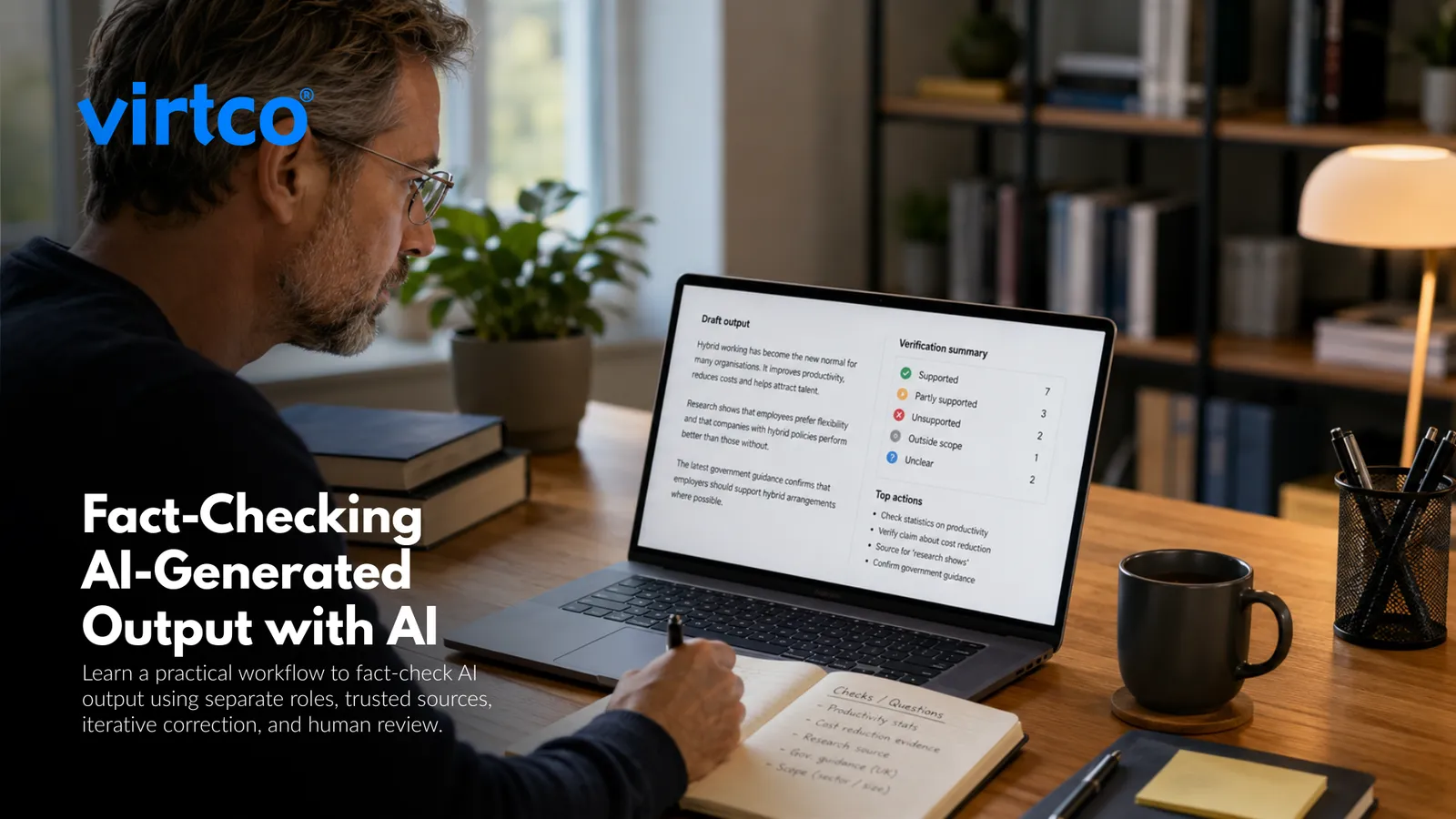
Don't blindly believe everything AI writes
Artificial intelligence large language models (LLMs) can write, summarise, analyse and draft at impressive speed. It can also be wrong with confidence.
That does not make AI unusable. It means AI output should be treated as a draft, not a decision. The practical question for businesses is not whether AI can ever be wrong. It is how to build a workflow that finds errors early, corrects them efficiently and keeps improving until the answer is accurate, useful and aligned to the original brief.
Used well, AI can help fact-check AI. The key is to separate generation from verification, define the role of each model interaction, ground the checking process in trusted sources and loop the findings back into the original output.
Why AI output needs a checking process
Large language models generate plausible text from patterns. They do not automatically know whether every sentence is true, current, complete or appropriate for the business context. OpenAI’s own guidance notes that ChatGPT can produce incorrect or misleading outputs, including fabricated quotes, studies, citations or references, and recommends verifying important information from reliable sources. (help.openai.com)
The issue is not only factual accuracy. AI-generated output can fail in several ways:
- Invented facts: numbers, names, dates, case studies or references that look credible but are not real.
- Outdated information: correct once, but no longer current.
- Over-generalisation: a statement that is broadly true but wrong for a specific sector, jurisdiction or customer.
- Missing caveats: an answer that ignores uncertainty, exceptions or risk.
- Brief drift: output that is polished but does not answer the question that was actually asked.
- Unsupported claims: statements that may be true, but cannot be evidenced.
This is why fact-checking should not be a final skim. It should be designed into the production workflow.
AI can help fact-check, but it should not mark its own homework
There is a useful distinction between using AI to assist verification and trusting AI to certify truth.
AI is good at extracting claims, comparing text against source material, highlighting inconsistencies, spotting missing evidence and suggesting questions for a human reviewer. It is less reliable when asked to make unsupported judgements from memory.
A stronger workflow gives the checking AI a narrower job:
- Read the original brief.
- Read the generated output.
- Extract factual claims.
- Check each claim against provided sources.
- Mark each claim as supported, unsupported, contradicted, unclear or outside scope.
- Suggest corrections.
- Confirm whether the revised output answers the brief.
That turns AI from a second writer into a quality control assistant.
NIST’s Generative AI Profile recommends evaluating claims of model capabilities using empirically validated methods and reviewing and verifying sources and citations in generative AI outputs during pre-deployment and ongoing monitoring. (nvlpubs.nist.gov) The same principle applies at the content and operational level: verification needs evidence, not confidence.
Start with the original brief
Most fact-checking workflows fail because they begin with the AI output rather than the task.
The first object to preserve is the original brief. It should define:
- the question to be answered;
- the intended audience;
- the required format;
- the acceptable sources;
- the level of detail required;
- any jurisdiction, date range, sector or product constraints;
- what the output must not do;
- what “accurate enough to publish or use” means.
If the checker does not have the brief, it can only ask, “Is this text plausible?” That is not enough. The better question is, “Does this text accurately answer the brief, using acceptable evidence, at the right level of confidence?”
For example, if the brief asks for “current UK employment law considerations for hybrid working”, a generic article about remote work is not accurate enough. It may be fluent, but it has failed on jurisdiction, currency and usefulness.
Defining the AI role matters
Role definition is not cosmetic. It changes the behaviour you ask the model to adopt.
Google’s prompt design guidance recommends clear and specific instructions, and describes prompt engineering as iterative: prompts should be refined based on the use case and observed responses. (ai.google.dev) A vague instruction such as “check this” produces vague checking. A defined role creates sharper output.
A practical workflow may use several roles:
1. The drafter
The drafter produces the first version. Its role is to answer the brief clearly, using the supplied material.
Useful prompt:
You are [the drafter]. Answer the brief using only the supplied context. If evidence is missing, flag it rather than inventing it. Write in plain British English for a business audience.
2. The claim extractor
The claim extractor does not rewrite. It turns the draft into a list of checkable statements.
Useful prompt:
You are the claim extractor. Identify every factual claim, number, date, named entity, quotation, source reference and implied causal claim in the draft. Do not judge them yet. Return a numbered list.
3. The evidence checker
The evidence checker compares each claim with trusted sources.
Useful prompt:
You are the evidence checker. For each claim, compare it with the approved source material. Mark it as Supported, Unsupported, Contradicted, Partly supported or Not checkable. Quote or cite the relevant source location where available. Do not use general knowledge.
4. The brief compliance reviewer
This role asks whether the output has done the job.
Useful prompt:
You are the brief compliance reviewer. Compare the revised output with the original brief. Identify missing requirements, unnecessary sections, unclear assumptions and any areas where the answer does not meet the intended audience’s needs.
5. The risk reviewer
For sensitive work, a separate risk lens is useful.
Useful prompt:
You are the risk reviewer. Identify claims that could create legal, financial, reputational, safety, privacy or compliance risk if wrong. Recommend which points need human expert review before publication or use.
By defining roles clearly, you avoid asking one AI interaction to be creative, sceptical, technical, legalistic and editorial all at once.
The loop: generate, check, correct, re-check
The best AI fact-checking workflow is iterative. It does not stop at finding errors. It feeds those errors back into the draft until the output is accurate and answers the brief.
A simple loop looks like this:
- Write the draft from the original brief and approved sources.
- Extract claims into a numbered checklist.
- Verify claims against trusted sources.
- Identify gaps where the output is unsupported, incomplete or off brief.
- Revise the output using only accepted corrections.
- Re-check the revised version against the same claim list and the original brief.
- Escalate uncertain items to a human subject matter expert.
- Capture the learning so the next prompt, source pack or workflow is better.
This is where AI becomes operationally useful. The system is not simply producing words. It is producing a trail of checks, corrections and decisions.
Virtco’s approach to AI adoption follows: find the real business bottleneck, establish a baseline, prove a controlled pilot, support adoption and then scale through connected agents rather than isolated tools. The same thinking applies to AI content and analysis workflows. Start with one measurable process, govern it, improve it, then scale what works.
A practical AI fact-checking workflow
For a business article, report, proposal or internal knowledge answer, the workflow could work as follows.
Step 1: Lock the brief
Before generating anything, create a short brief record:
- objective;
- audience;
- sources allowed;
- claims that must be evidenced;
- claims that must not be made;
- tone and format;
- approval owner.
This prevents later arguments about whether the output is “good”. Good means it satisfies the agreed brief.
Step 2: Generate with constraints
The drafting prompt should include boundaries:
Use only the source pack provided. Do not invent statistics, examples, client names, case studies or quotations. If a useful point is missing evidence, write [evidence needed] and continue.
This is more effective than asking for a polished final answer immediately.
Step 3: Break the output into atomic claims
AI-generated text often hides several claims inside one fluent sentence.
For example:
“AI fact-checking tools reduce review time and improve compliance confidence for regulated firms.”
That contains at least three separate claims:
- AI fact-checking tools reduce review time.
- They improve compliance confidence.
- The statement applies to regulated firms.
Each needs separate evidence. If only one is supported, the sentence must be rewritten.
Step 4: Check against trusted sources
The checker should be given a defined source hierarchy:
- primary legal, regulatory or technical sources;
- internal approved documentation;
- customer-approved material;
- reputable research or industry sources;
- general web sources only where appropriate.
For internal business content, a retrieval-augmented generation workflow can help by pulling from approved documents rather than asking the model to rely on memory. Virtco’s AI solution proposition gmented generation, prompt engineering, agentic workflows and user-friendly interfaces as core capabilities for building customised AI applications.
Step 5: Rewrite from the evidence, not from memory
The revision prompt should be strict:
Revise the draft using the fact-check report. Remove unsupported claims. Correct contradicted claims. Add caveats where the evidence is partial. Preserve the original brief and structure. Do not introduce new claims unless they are supported by the source pack.
This prevents the repair stage from adding a fresh layer of unsupported material.
Step 6: Re-check the revised answer against the brief
The final check should ask two questions:
- Is every important factual claim supported?
- Does the output answer the original brief?
The second question matters. A factually accurate answer can still be a poor answer if it misses the user’s intent.
OpenAI’s evaluation guidance describes evaluations as structured tests that help assess accuracy, performance and reliability despite the variability of generative AI systems. (platform.openai.com) Businesses should apply the same principle to repeated AI workflows: define what good looks like, test against it, and use the results to improve.
What to capture for continuous improvement
Every correction is useful data.
A mature workflow should log:
- unsupported claims;
- recurring hallucinations;
- weak source areas;
- prompts that caused drift;
- questions the AI could not answer;
- points escalated to humans;
- corrections accepted by reviewers;
- corrections rejected by reviewers;
- final approved wording.
Those signals can improve the original prompts, source packs, retrieval rules, editorial checklists and approval policies.
This mirrors the self-improving operating model described in Vircapture errors, edge cases, rejected recommendations, corrected outputs and successful resolutions, then use those signals to improve prompts, rules, retrieval sources, training material, workflow design and governance.
Where humans still matter
AI can reduce the burden of checking, but it should not remove accountability.
Human review is still essential when the output involves:
- legal, medical, financial or safety advice;
- regulated communications;
- public claims about customers, competitors or partners;
- statistics used in sales material;
- contractual interpretation;
- personal data;
- brand reputation;
- strategic decisions.
The human role should be explicit. A reviewer should not be asked to “look over it” with no criteria. They should receive the brief, the draft, the claim list, the evidence report and the remaining open questions.
That is how AI saves time without lowering standards.
Common mistakes to avoid
Asking the same model to approve its own work in the same context
A second pass is useful, but only if the task changes. Ask for evidence checking, contradiction detection or brief compliance. Do not just ask, “Are you sure?”
Checking only the obvious numbers
Dates and statistics matter, but so do implied claims. “This is the best option”, “customers prefer”, “regulators require” and “integration is simple” are all claims.
Letting the checker browse without constraints
Uncontrolled web access can introduce weak sources. Define what counts as acceptable evidence.
Fixing errors without updating the prompt
If the same error appears repeatedly, the workflow is teaching you something. Improve the instructions, the source set or the retrieval logic.
Publishing fluent uncertainty
If the answer is not fully known, say so. A useful AI workflow should make uncertainty visible, not hide it in polished prose.
The business value of AI-assisted fact-checking
The value is not merely cleaner copy. It is better operational control.
A good AI-assisted fact-checking workflow helps organisations:
- publish with more confidence;
- reduce rework;
- make review effort more targeted;
- create an audit trail for sensitive outputs;
- improve prompts and knowledge bases over time;
- protect brand trust;
- keep humans focused on judgement rather than mechanical checking.
For teams already using AI daily, this is the difference between experimentation and a managed capability.
Build the loop before you scale the output
AI makes it easy to generate more. That is useful only if the organisation can also verify more.
The practical answer is not to ban AI-generated output or to trust it blindly. It is to design a loop:
brief → draft → claim extraction → evidence check → correction → re-check → approval → learning
Define the role. Ground the checker. Preserve the original brief. Improve the draft until it is both accurate and useful. Then capture what the workflow learned so the next output starts from a better place.
If your organisation is ready to move from ad hoc AI use to governed, measurable workflows, visit the virtco® AI transformation page and start with one process where accuracy, speed and control all matter.