


The AI-First Org Chart
By Grant Crawley · 24 June 2026
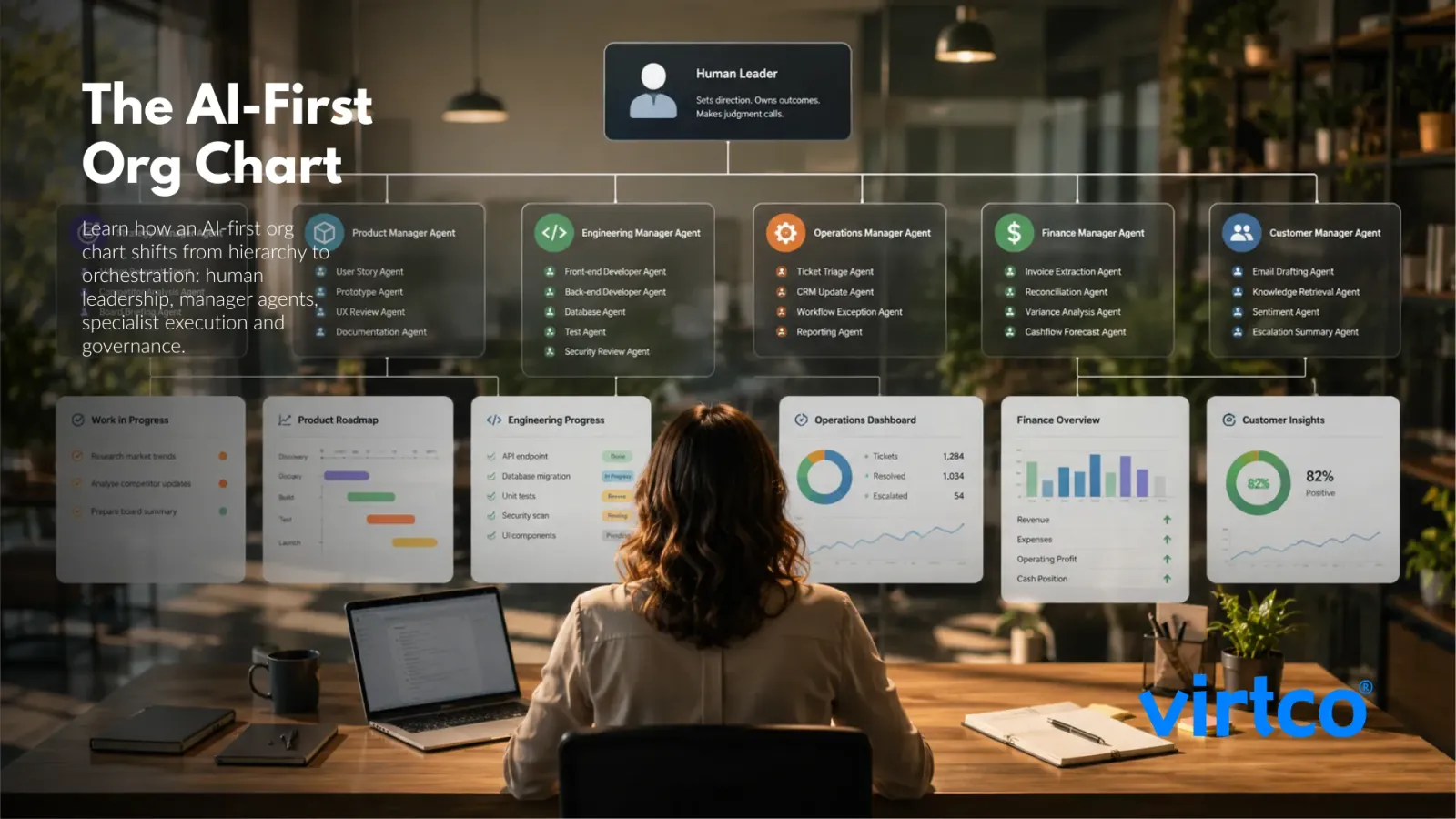
Most businesses still draw their organisation chart as if intelligence only lives in people.
At the top sits the chief executive officer. Beneath them are directors, then managers, then individual contributors. Information travels up. Decisions travel down. Work moves sideways through meetings, tickets, hand-offs and updates.
An AI-first business needs a different mental model.
The chief executive officer still matters. In fact, the human leader matters more. But the shape beneath them changes. Instead of using artificial intelligence as a tool bolted onto each department, the business starts to operate like a flat, agent-augmented organisation: a small number of human owners, supported by manager agents and individual contributor agents that can plan, research, draft, build, test, summarise, monitor and escalate.
This is not science fiction. It is the operating pattern many of us have already discovered through AI-augmented development and so-called vibe coding.
I’ve found that when coding with AI it really pays off to delegate tiny tasks that can be clearly defined. That means you really need to understand your architecture so you can conduct your army of agents to deliver the building blocks when and where they’re needed. But you don’t need to plan it all out yourself. Use a manager agent to orchestrate the individual contributor agents.
That sentence is more than a coding tip. It is the beginning of a new org chart.
From hierarchy to orchestration
Traditional hierarchy exists because coordination is expensive.
When people need context, decisions, approvals and priorities, organisations add managers. When managers become overloaded, they add more managers. Eventually the business develops layers whose main purpose is to move information around.
AI changes that cost structure.
A well-designed agent can read a backlog, search a knowledge base, summarise a meeting, draft a response, create a pull request, compare policy rules, prepare a report or ask for missing information. A manager agent can break a goal into smaller tasks, route those tasks to specialist agents, check progress, detect conflicts and prepare a decision for the human owner.
That does not remove leadership. It changes leadership from supervision to orchestration.
Virtco’s existing view of AI-first operating models makes the same distinction: coordination layers may reduce, but leaders and senior specialists still need to define outcomes, remove ambiguity, set decision rights, maintain standards, review exceptions and protect customers and staff from poorly governed automation .
The AI-first org chart is therefore flatter, but not leaderless.
The new structure: human vision, agent management, specialist execution
A practical AI-first structure has three layers.
| Layer | Role | Primary question |
|---|---|---|
| Human leadership | Sets direction, owns risk and makes judgement calls | What outcome matters, and why? |
| Manager agents | Plan, sequence, delegate, monitor and escalate | How should the work be broken down and controlled? |
| Individual contributor agents | Execute bounded tasks using approved tools and context | What specific output is needed now? |
The key is that the layers are functional, not bureaucratic.
The human leader does not need to brief every agent directly. They define the outcome, the constraints and the standard of judgement. The manager agent turns that into a plan. The individual contributor agents execute small, reviewable units of work.
In software development, that might look like this:
- The human chief executive officer or product owner defines the product intent.
- A product manager agent turns the intent into user stories, acceptance criteria and a release plan.
- An architecture agent checks the proposed approach against the existing system design.
- An engineering manager agent decomposes the work into small implementation tasks.
- Developer agents build individual components, database changes, Application Programming Interface endpoints or user interface states.
- A test agent writes and runs test cases.
- A documentation agent updates release notes, technical notes and user guidance.
- A security agent reviews permissions, secrets, dependencies and data exposure.
- The human owner reviews the integrated result, makes judgement calls and approves release.
This is very similar to a high-performing flat software team. The difference is that many of the roles are agentic, cheap to replicate and available on demand.
The chief executive officer becomes the architect of intent
The most important person in an AI-first business is not the person who writes the most prompts. It is the person who understands the system.
In AI-augmented coding, the breakthrough comes when you stop asking the model to “build the app” and start giving it precise, bounded work:
- “Create the validation function for this form.”
- “Refactor this component without changing the public interface.”
- “Write tests for these three edge cases.”
- “Compare this implementation against the architecture notes.”
- “Summarise the trade-offs between these two persistence options.”
Tiny tasks work because they reduce ambiguity. They also make review possible.
The same principle applies to the business. An AI-first chief executive officer must be able to express the organisation’s architecture:
- how value is created;
- where decisions are made;
- which workflows matter;
- what data is trusted;
- where risk lives;
- what good quality looks like;
- which actions require approval;
- which outcomes are worth optimising.
This is why AI-first leadership is not about surrendering control to automation. It is about making the business legible enough that agents can operate safely within it.
Manager agents: the missing layer between ambition and execution
Many failed AI experiments happen because the human tries to manage every interaction directly.
That works for a single task. It fails at scale.
If you have ten agents, you do not want ten unstructured conversations. You want a manager agent that can convert a goal into a plan, assign work, consolidate outputs and ask for decisions only when needed.
A useful manager agent should be able to:
- Restate the objective in plain English.
- Identify missing context.
- Break the objective into small tasks.
- Assign each task to the right specialist agent.
- Define the expected output and acceptance criteria.
- Track dependencies between tasks.
- Flag conflicts, uncertainty and risk.
- Summarise progress for the human owner.
- Prepare recommendations rather than force the human to inspect everything.
- Capture lessons for the next cycle.
In a coding context, the manager agent might act like a technical lead. In operations, it might act like a process manager. In sales, it might act like a revenue operations coordinator. In finance, it might act like a controller preparing reconciliations and exceptions for review.
The point is not to pretend the manager agent is a human manager. The point is to use it as an orchestration layer.
Virtco’s agentic pod model reflects this shift: one process owner can supervise a small “factory” of agents, with one reading emails, another updating the customer relationship management system, another drafting a response and the human approving the work .
Individual contributor agents: small jobs, clear standards
Individual contributor agents should not be asked to “do marketing”, “run finance” or “build the product”. Those are too vague.
They should be given narrowly defined jobs.
Examples include:
- summarise these ten customer tickets by theme;
- extract invoice numbers, dates and totals from these documents;
- draft a reply using this approved policy;
- generate test cases for this function;
- identify inconsistencies between these two spreadsheets;
- update this customer record using these fields;
- produce three headline options in this tone of voice;
- compare this contract clause against the standard position;
- prepare a one-page briefing note for the account manager.
The smaller the unit of work, the easier it is to review. The easier it is to review, the safer it is to scale.
This is one of the strongest lessons from AI-assisted development. When code generation becomes faster, the bottleneck shifts towards problem definition, architecture, security review, test design, integration quality, product judgement, maintainability and user adoption .
In other words, the winning organisation is not the one that generates the most output. It is the one that can specify, integrate and govern that output.
The AI-first org chart in practice
A simple AI-first org chart might look like this:
Human CEO / Founder / Managing Director
│
├── Strategy Manager Agent
│   ├── Market Research Agent
│   ├── Competitor Analysis Agent
│   └── Board Briefing Agent
│
├── Product Manager Agent
│   ├── User Story Agent
│   ├── Prototype Agent
│   ├── UX Review Agent
│   └── Documentation Agent
│
├── Engineering Manager Agent
│   ├── Front-end Developer Agent
│   ├── Back-end Developer Agent
│   ├── Database Agent
│   ├── Test Agent
│   └── Security Review Agent
│
├── Operations Manager Agent
│   ├── Ticket Triage Agent
│   ├── CRM Update Agent
│   ├── Workflow Exception Agent
│   └── Reporting Agent
│
├── Finance Manager Agent
│   ├── Invoice Extraction Agent
│   ├── Reconciliation Agent
│   ├── Variance Analysis Agent
│   └── Cashflow Forecast Agent
│
└── Customer Manager Agent
    ├── Email Drafting Agent
    ├── Knowledge Retrieval Agent
    ├── Sentiment Agent
    └── Escalation Summary Agent
This is not a recommendation to replace departments overnight. It is a way to visualise work.
The practical question is: where does your business already have repeatable work that can be decomposed into small, reviewable tasks?
That is where the first agentic team belongs.
The flat structure still needs clear accountability
A dangerous version of the AI-first org chart says: “The agents did it.”
That is not acceptable.
Agents can support work, but accountability must remain human. Virtco’s guidance is explicit on this point: assign a directly responsible individual for every important operational outcome; agents can support the work, but accountability remains with people .
This means every agentic team needs a human owner.
That person owns:
- the business outcome;
- the risk boundary;
- the approved data sources;
- the escalation route;
- the quality standard;
- the decision to deploy or stop the workflow.
In a flat AI-first business, the human owner is not there to copy and paste. They are there to exercise judgement.
The operating system behind the org chart
An org chart is only useful if the operating system beneath it is clear.
An AI-first business needs five practical layers.
1. Shared context
Agents need a reliable source of truth. Without it, they work from partial information, duplicated files and conflicting versions of reality.
A shared organisational brain may include structured databases, approved document repositories, process maps, customer records, policies, reusable prompts, standard operating procedures, decision logs, integration histories and performance data .
2. Policy and permissions
The business must define what agents can and cannot do.
This includes:
- which systems they can access;
- whether access is read-only or write-enabled;
- which data is sensitive;
- which outputs need review;
- which actions are prohibited;
- what happens when confidence is low.
The policy layer turns business rules, legal obligations, brand standards, security policies and risk appetite into operational controls .
3. Tool access
Agents become useful when they can call tools: query a database, update a record, create a task, draft a document, schedule a meeting or raise an alert.
But tools should be deterministic, permissioned and observable. The AI should not be allowed to improvise unrestricted actions in business-critical systems .
4. Quality gates
The quality gate sits between recommendation and action.
It may include automated checks, confidence thresholds, policy validation, human review, audit logging, approval workflows and exception routing .
This is where “human in the loop” becomes operational rather than decorative.
5. Learning loop
The organisation should capture errors, edge cases, rejected recommendations, corrected outputs, customer responses, escalation reasons, process delays and successful resolutions, then use those signals to improve prompts, rules, retrieval sources, workflow design and governance .
That is how an AI-first business becomes self-improving.
A working pattern for AI-augmented coding
The easiest place to understand the AI-first org chart is software delivery.
Here is a practical pattern.
Step 1: Write the architecture brief
Before assigning tasks, describe the architecture:
- system purpose;
- core data model;
- important modules;
- public interfaces;
- constraints;
- security assumptions;
- coding standards;
- testing approach;
- deployment model.
This is the equivalent of briefing your management team.
Step 2: Ask a manager agent to create the work breakdown
The manager agent should turn the architecture brief into small work packets.
Each packet should include:
- task objective;
- relevant files or context;
- constraints;
- expected output;
- definition of done;
- tests required;
- known risks;
- dependencies.
Step 3: Assign individual contributor agents
Each specialist agent receives one bounded task.
Do not ask one agent to redesign the product, change the database, rewrite the front end and update the tests in a single instruction. That creates review debt.
Step 4: Integrate deliberately
The human or manager agent reviews outputs before they are merged.
For coding, that means tests, pull requests, static checks and architectural review. For business processes, it means approval queues, audit logs and exception handling.
Step 5: Capture what changed
At the end of each cycle, update the shared context:
- what worked;
- what failed;
- what assumptions changed;
- what patterns should be reused;
- what standards need tightening.
The next cycle should start smarter than the last.
Virtco’s internal AI-augmented vibe coding evidence base makes the same caveat: productivity gains depended on the expert practitioner steering, reviewing and accepting the work; the practitioner’s expertise, not AI autonomy, was the indispensable driver .
The first AI-first team should be a pod, not a platform
Many businesses make the mistake of trying to design the whole AI operating model before proving one useful workflow.
A better approach is to start with one pod.
Choose a process that is:
- frequent;
- painful;
- measurable;
- bounded;
- low enough risk to pilot safely;
- important enough that improvement matters.
Virtco’s thin-slice pilot approach recommends selecting one task, setting a baseline for time, quality and volume, and avoiding the temptation to bundle several problems together .
That might be:
- support ticket triage;
- invoice extraction;
- quote generation;
- compliance evidence gathering;
- meeting-note conversion into actions;
- customer email drafting;
- internal knowledge retrieval;
- software test generation.
Build the smallest useful org chart for that workflow:
Human Process Owner
│
├── Manager Agent
│   ├── Intake Agent
│   ├── Classification Agent
│   ├── Drafting Agent
│   ├── Quality Check Agent
│   └── Escalation Agent
Then measure it.
Useful metrics include cycle time, cost per completed outcome, escalation rate, percentage of work completed without rework, quality review pass rate, audit pass rate, time saved per workflow and employee adoption .
What changes for human teams
The AI-first org chart does not make people irrelevant. It changes the work people should be doing.
Humans move towards:
- setting direction;
- defining outcomes;
- designing systems;
- handling exceptions;
- reviewing quality;
- building relationships;
- making ethical and commercial judgements;
- improving the operating model.
Agents take on more of the repeatable work:
- searching;
- summarising;
- drafting;
- comparing;
- classifying;
- extracting;
- routing;
- checking;
- preparing.
This shift needs careful communication. People should not be told that AI is arriving to “replace” them. They should be shown which drudgery is being removed, what new skills matter and how approval, escalation and accountability will work.
Virtco’s adoption guidance makes this point plainly: the technology is often the easier part; people need training, acceptable use rules and AI literacy so they know how to prompt, how to spot hallucinations and how to work safely with the system .
The risks of the AI-first org chart
The model is powerful, but it can fail badly if governance is weak.
Common failure modes include:
- agents using outdated or unapproved information;
- too many disconnected tools creating silos;
- no human owner for the outcome;
- unclear approval thresholds;
- automated errors propagating into live systems;
- code being generated faster than it can be reviewed;
- sensitive data being exposed to the wrong model or workflow;
- managers mistaking activity for value;
- pilots with no baseline and therefore no credible return on investment.
The answer is not to avoid agents. The answer is to design the control model from the start.
That means role-based access, audit logs, approval gates, restricted tool registries, sandbox environments, clear data retention rules and escalation paths for uncertain outputs .
How to draw your first AI-first org chart
If you want to apply this in your own business, start with one workflow and ask ten questions.
- What outcome are we trying to improve?
- Who is the human owner?
- What information does the work require?
- Which parts of the work are repeatable?
- Which parts require judgement?
- What can an agent do without approval?
- What must always be reviewed by a person?
- Which specialist agents are needed?
- What does the manager agent coordinate?
- How will we measure quality, speed, risk and adoption?
Then draw the pod.
Keep it small. Keep it measurable. Keep the human owner visible.
The future business is not human or AI. It is human-led and agent-operated
The best AI-first businesses will not be the ones with the most agents. They will be the ones with the clearest operating model.
They will understand their architecture. They will break work into small, well-defined tasks. They will use manager agents to coordinate individual contributor agents. They will keep humans accountable for outcomes, judgement and trust. They will build quality gates into the workflow rather than trying to inspect everything after the fact.
That is the real lesson from AI-augmented coding.
The chief executive officer becomes the conductor. The manager agents keep the sections in time. The individual contributor agents play their parts. The score is the architecture of the business.
When that architecture is clear, the organisation can move faster without becoming chaotic.
If you want to explore where an AI-first operating model could remove friction in your own business, talk to virtco® about mapping your first agentic pod and turning it into a measurable pilot.