


Value Stream Mapping for AI Integration
By Grant Crawley · 9 June 2026
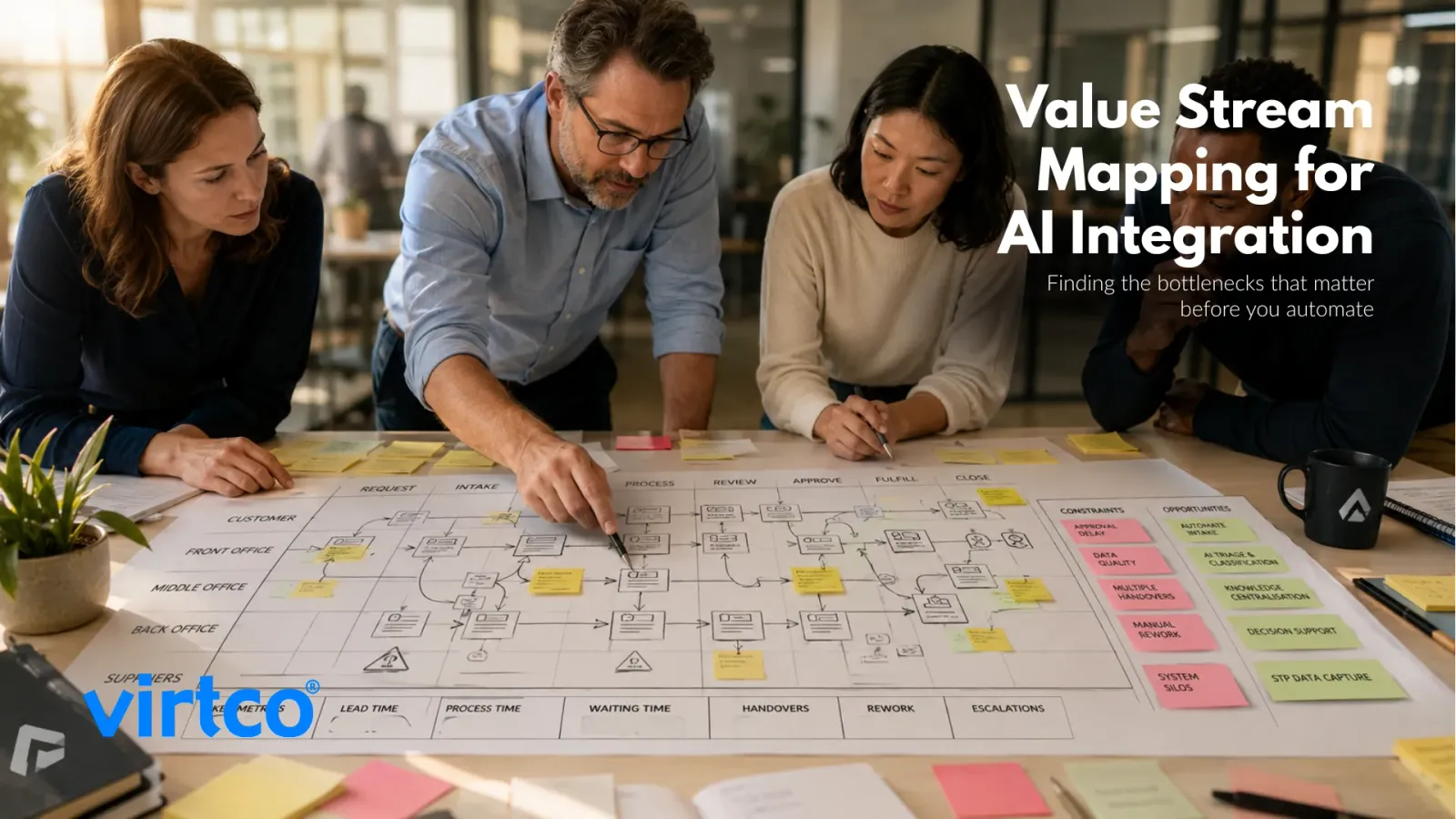
Finding the Bottlenecks That Matter Before You Automate
Artificial intelligence (AI) is often introduced as if the technology itself will create the value. A model is selected, a pilot is launched, a workflow is automated and the organisation waits for the productivity improvement to appear.
That is the wrong sequence.
Before an organisation integrates AI into its operations, it needs to understand how value actually flows today: where work enters the system, where it waits, where judgement is required, where data is re-keyed, where handovers fail, where governance slows decisions, and where customers or colleagues feel the friction. That is the purpose of value stream mapping.
Value stream mapping is not a documentation exercise. Done properly, it is the diagnostic work that tells leaders where AI can unlock genuine system value and where it will merely make an already flawed process run faster.
The lesson from the dynamo
Paul A. David’s 1990 paper, The Dynamo and the Computer: An Historical Perspective on the Modern Productivity Paradox, is a useful warning for today’s AI programmes. The paper appeared in the American Economic Review in 1990 and explored why major technologies can take time to show up in productivity performance. (econpapers.repec.org)
The historical comparison is electrification. Early adopters did not immediately redesign factories around electric power. Many simply replaced the central steam engine with a central dynamo, leaving the same shaft, belt and pulley logic in place. The power source had changed, but the operating model had not. Productivity gains remained limited until managers reorganised factories around distributed electric motors, changing layouts, workflows and the structure of production itself. (acawiki.org)
That lesson matters for AI. If an organisation adds AI to an existing process without understanding the process, it may be repeating the “central dynamo” mistake: using a new technology to preserve an old system.
The real question is not, “Where can we add AI?” It is, “Which constraint in the value stream does AI now allow us to remove?”
AI does not remove the need for process thinking
AI can summarise documents, classify requests, draft responses, extract data, generate code, search knowledge bases, forecast demand and support decision-making. But none of those capabilities automatically create value in isolation.
A customer service team may use AI to draft replies, but if the real bottleneck is poor knowledge management, unresolved policy ambiguity or slow second-line escalation, faster drafting will not solve the system problem.
A finance team may use AI to read invoices, but if supplier data is inconsistent, approval rules are unclear and exceptions are handled through informal inboxes, automation may simply move the queue elsewhere.
A sales team may use AI to produce proposals, but if pricing approvals, product configuration and legal review remain disconnected, the headline gain will disappear into downstream waiting time.
This is why value stream mapping should sit before AI solution design. It makes the whole system visible before the organisation chooses the intervention.
The bottleneck AI unlocks is not always the obvious one
One of the most common mistakes in AI adoption is to start with the most visible pain point. That pain point may be real, but it may not be the constraint that governs the performance of the whole system.
A value stream map helps teams distinguish between:
- local inefficiency — a task that feels slow or frustrating;
- system constraint — the point that limits throughput, quality, cost or customer experience;
- failure demand — work created by earlier errors, unclear instructions or missing information;
- handover loss — delay or rework caused when work crosses team, system or accountability boundaries;
- decision latency — time lost because authority, evidence or risk appetite is unclear;
- data friction — effort caused by missing, duplicated, inaccessible or untrusted data.
AI may help with any of these. But the right design depends on knowing which one matters most.
This is also where AI changes the economics of transformation. virtco®’s Outcome Engineering work describes an “AI inversion”: software construction is becoming cheaper and faster, while problem definition, socio-technical workflow mapping, prioritisation, measurement, adoption and optimisation become the scarce capabilities. Building the wrong solution faster produces a poor return; identifying the right constraint becomes the strategic work.
What value stream mapping should reveal before AI is introduced
A useful AI value stream map should not only describe process steps. It should expose the practical conditions for value.
At minimum, it should answer seven questions.
1. What outcome are we trying to improve?
AI work should begin with a measurable business outcome, not a preferred tool. virtco® defines Outcome Engineering™ as the systematic identification, design, implementation, measurement and continuous optimisation of interventions intended to achieve specific business outcomes. In that philosophy, software and AI are possible interventions, not the objective itself.
2. Where is the baseline?
If the current state is not measured, the future state cannot be proven. For AI, that usually means capturing time, cost, quality, volume, error rate, rework, escalation, customer impact and risk exposure before the pilot starts.
virtco®’s thin-slice AI pilot approach follows the same discipline: one operational bottleneck, one accountable business owner, one controlled user group, one baseline measurement, one target improvement and one 30-day evidence window.
3. Where does work wait?
Waiting time is often more important than task time. AI may reduce a five-minute activity to one minute, but if the work then waits three days for approval, the customer sees little improvement.
4. Where is judgement required?
AI is most valuable when it supports repeatable judgement at scale: triage, classification, summarisation, prioritisation, evidence gathering or recommendation. But judgement points must be mapped carefully, because they often carry legal, ethical, operational or reputational risk.
5. Where does data break the flow?
AI depends on usable data. Value stream mapping should identify where data is missing, duplicated, manually transferred, poorly governed or trapped in systems that do not speak to each other.
6. Who must change how they work?
AI adoption is not just a technical deployment. It changes roles, confidence, skills, accountability and trust. virtco® runs engineering and change streams in parallel, using ADKAR® to plan Awareness, Desire, Knowledge, Ability and Reinforcement across the delivery lifecycle.
7. What risk is being introduced or amplified?
AI can create new operational, technical, security, compliance, financial, strategic and reputational risks. virtco®’s AI Risk Framework™ is designed as a continuous, adaptive approach to identifying, quantifying and managing AI risk, with the Risk Radar™ helping leaders see where attention is required.
From process map to value map
A traditional process map shows what happens. A value stream map shows how work flows. A benefits map shows why the change is worth making.
AI programmes need all three.
This is where virtco®’s 3-Bees™ framework is particularly relevant. The framework moves through Benefits Capture, Benefits Mapping & Profiling, and Benefits Realisation. It starts by defining the vision, stakeholders, target benefits, baselines, risks, constraints and business case. It then builds a benefits dependency map linking enablers, business changes, intermediate benefits, end benefits and strategic objectives.
That is important because AI does not create value at the point of installation. Value appears when a new capability changes how work is done, when people adopt that change, when measurement confirms the improvement and when the operating model reinforces it.
A good AI value stream mapping exercise should therefore produce more than a diagram. It should create:
- a prioritised list of constraints;
- baseline measures for the current state;
- candidate AI and non-AI interventions;
- a benefits dependency map;
- named benefit owners;
- a target operating model;
- risk and dependency visibility;
- a measurement plan;
- a thin-slice pilot backlog.
The danger of automating waste
Without value stream mapping, AI can easily automate waste.
It can generate faster emails that should not need to be written. It can summarise documents that should be shorter. It can classify requests that should arrive through a clearer service route. It can extract data from forms that should be redesigned. It can build reports that nobody uses to make decisions.
This is the AI version of installing a dynamo into the old factory.
The technology may be impressive. The operating model remains unchanged. The bottleneck moves, the benefit disappoints and the organisation concludes that AI was overhyped.
The better approach is to use value stream mapping to ask harder questions:
- Can this step be removed rather than automated?
- Can the decision be moved closer to the work?
- Can the data be captured once, at source?
- Can the knowledge be made reusable?
- Can the handover be eliminated?
- Can the customer self-serve safely?
- Can AI assist the human at the constraint rather than decorate the workflow around it?
How virtco® accelerates the process
virtco®’s philosophy is well suited to this challenge because it is outcome-led rather than tool-led.
The engagement starts by identifying the business outcome and the current constraint. It then maps the value stream, establishes the baseline, quantifies the opportunity and selects the smallest credible intervention that can prove value. That intervention may involve AI, automation, workflow redesign, integration, governance, training, knowledge management or custom software. The point is not to deploy AI for its own sake. The point is to engineer a measurable improvement.
virtco®’s Outcome Engineering Playbook™ follows this logic through Outcome Discovery, Opportunity Mapping, Intervention Design, Rapid Implementation, Outcome Measurement, Optimisation and Scaling. It explicitly treats software as one possible intervention among many and uses benefits dependency networks to show how intermediate benefits connect to strategic objectives.
For AI-specific work, virtco® can combine:
- Value stream mapping to expose the constraint;
- Outcome Engineering™ to define the measurable business result;
- the virtco® Value Map™ to connect technology, business change and strategic value;
- the virtco® Value Equation™ to quantify the worth of each benefit;
- the 3-Bees™ framework to capture, map and realise benefits;
- thin-slice AI pilots to prove one high-value use case before scaling;
- ADKAR®-based adoption planning to build user confidence and capability;
- the virtco® AI Risk Framework™ and Risk Radar™ to keep risk visible and managed.
This creates a faster route to useful AI because it avoids false starts. The organisation does not spend months building a broad pilot with unclear measures. It starts with the value stream, finds the constraint, proves a targeted improvement, then scales what the evidence supports.
If your organisation is considering AI integration, speak to virtco® about turning AI ambition into measurable business value.
The leadership takeaway
AI integration should not begin with a model, a vendor demo or a list of possible use cases. It should begin with the value stream.
Paul David’s lesson from the dynamo is that transformational technologies produce their full value only when organisations redesign the system around the capability the technology unlocks. Modern AI research makes a similar point: the full effects of AI depend on complementary innovations, organisational change and new skills, not technology diffusion alone. (nber.org)
Value stream mapping is how leaders find where that redesign should begin.
It shows where the work really flows, where it stalls, where risk accumulates and where AI can remove a genuine constraint. Without it, AI adoption risks becoming faster activity without better outcomes. With it, AI becomes part of a disciplined transformation process: discover, measure, improve and scale.